Welcome to the WiS Lab
@ Toronto Metropolitan University
Wireless Sensing
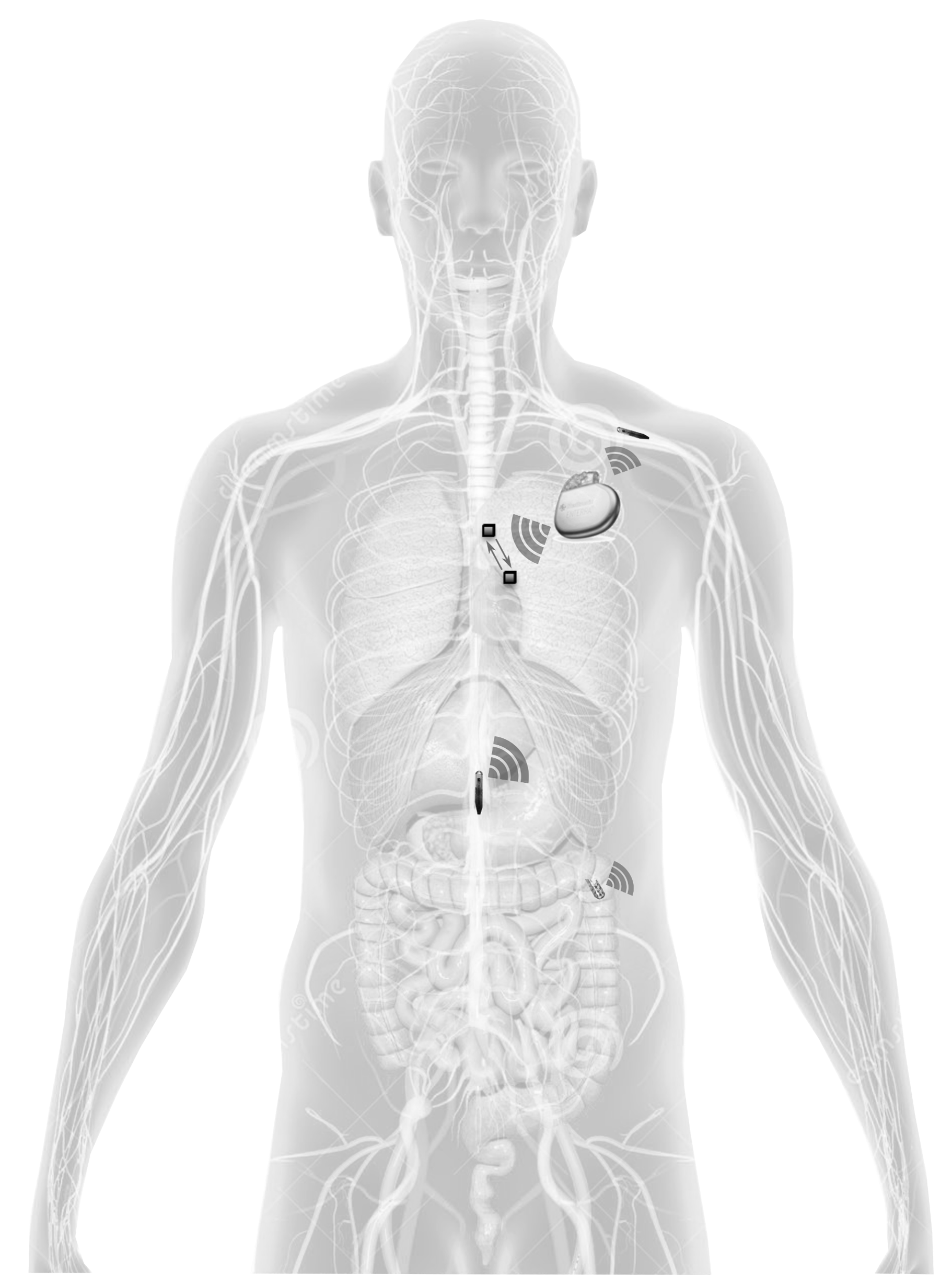
Wireless medical sensors represent one of today’s disruptive technologies that have significantly improved the quality of life of patients, especially those affected by chronic conditions. Compared to wired sensors, wireless sensors allow for long-term continuous health monitoring without affecting patients’ daily activities. In the last decade we have witnessed significant clinical adoption of wearable sensors, including ECG patches and glucose monitors, which have resulted in more efficient chronic disease management.
In the context of implantable devices, a number of wireless sensors have recently been introduced (e.g. loop recorders and pressure sensors), that supplement the functionality of existing implants in cardiac patients. These sensors are however limited to either collecting and storing data that is later analyzed by health professional or require significant patient’s compliance. The single-parameter nature of such sensors further limits their scope.
Current clinical needs call for the development of minimally-invasive multimodal wireless sensor networks, that can capture clinically-relevant parameters and provide real-time predictive monitoring of a patient’s condition. This ambition presents a number of interesting technical challenges, related to the size, functionality, connectivity and powering of these sensor networks, that require innovative and sustainable solutions.
Latest News
o Sept 2025. Kanhchana will continue her academic journey in the WiS Lab as a PhD student, working on piezo-haptics for wearable assistive gait rehablitation devices. Welcome (back) Kanhchana!
o Sept 2025. Saad has passed the M.Eng Oral Exam with very minor corrections! Well done Saad!
o Aug 2025. Irene has passed the MASc Oral Exam with minor corrections! Well done Irene!
o Aug 2025. Fertilead and the WiS Lab awarded the BioHubNet VentureLift Grant to develop a home-based male infertility test kit. Announcing EQUIP Grant Recipient – BioHubNet
o Apr 2025. Shae has passed the MASc Oral Exam with minor corrections! Well done Shae!
o Apr 2025. Kanhchana has passed the M.Eng Oral Exam with very minor corrections! Well done Kanhchana!
o Mar 2025. Narjes accepted in the Lab2Market program!
o Sept 2024. Sam (MASc) and Danny (MEng) join the WiS Lab! Welcome both!
o May 2024. Hanieh awarded one of the Predoctoral Grants at ISCAS 2024 (IEEE ISCAS 2024 | Home (ieee-iscas.org))! Well done Hanieh!
o Apr 2024. The WiS Lab and Fertilead (fertilead.com) awarded a Mitacs Accelerate grant to develop a medical device to enhance fertility treatments.
o Apr 2024. MSc student Noah Becker joins the WiS Lab as a visiting student from Karlsruhe University of Applied Sciences, Germany. Welcome Noah!
…more news
About the WiS Lab

The Wireless Sensing (WiS) Lab works on the design and development of mm-scale CMOS-MEMS sensing devices to complement implantable devices for efficient management of chronic diseases. The lab was founded in 2020 by Dr. Virgilio “Vivo” Valente, who is currently an Assistant Professor in the Department of Electrical, Computer and Biomedical Engineering at Toronto Metropolitan University* University. The Lab combines research activities in microelectronics, MEMS fabrication and wireless power and data transfer. Our research activities are centered on 3 main areas:
o Ultra-low-power CMOS wireless sensor readout circuits
o Wireless powering and CMOS-MEMS energy harvesters
o Monolithic integration of MEMS sensors, CMOS circuits and microfluidic structures
The Lab has expertise in many domains, including mixed-mode CMOS circuit design, sensor modeling, design and characterization, wireless power and data transfer, CMOS post-processing, MEMS design and fabrication. The Lab’s research activities are currently supported by the National Science and Engineering Research Council (NSERC) and Mitacs. Read more.
*Formerly Ryerson University
We currently have fully-funded opportunities for domestic MASc and PhD students in the field of IC design, BioMEMS and wireless sensing.
Current Projects
o ULP wireless CMOS potentiostat with time-based readout for wearable and implantable biosensors. This project builds on previous activities on the development of low-power wireless potentiostats. In this project we are developing a novel wireless CMOS potentiostat that combines a time-based, current-input SAR readout with a pulse-harmonic modulation wireless transmitter. The potentiostat readout is designed to accommodate input current in a range between 10 pA and 10μA with a maximum energy consumption of less than 100 pJ/bit. Further work focuses on multi-channel and multi-modal operation through the design of reconfigurable time-based front-end readouts.
10.1109/MWSCAS60917.2024.10658765
10.1109/PRIME58259.2023.10161938
o Time-based CMOS impedance analyzer for bioimpedance and electrical impedance spectroscopy application. Synchronous demodulation is the industry standard for real-time impedance measurement. This method provides high resolution but at the cost of high power consumption. In this project we explore alternative methods to measure impedance using time-based readouts. Currently we are developing a model of a single-channel time-based impedance readout and investigating its theoretical performance.
https://doi.org/10.1049/ell2.70181
o Dual-parameter LC sensor and inductive MEMS pressure sensors. In this project we explore novel designs of dual-parameter LC sensors, whereby both the inductor and capacitor can be used as sensors (patent pending). We are also exploring a novel design of an inductive pressure sensor, based on changes in mutual inductance between a flexible and a fixed coil. We are currently working on the monolithic integration of dual-parameter LC sensors in CMOS techhologies MEMS inductors and capacitors on silicon substrates.
10.1109/LSENS.2024.3508272
10.1109/BioCAS58349.2023.10389171
o Silicon microfluidic device with planar patch-clamp (PPC) structures and microelectrode arrays (MEAs) for simultaneous recording on intra- and extra-cellular cell activity. Patch clamps represent the golden standard in single-cell biology, but require expensive equipment and trained personnel. In this project we are fabricating a silicon lab-on-a-chip device that integrates PPCs and MEAs in the same substrate. The chip will be part of an automated single-cell analysis system for cell biology. This project is in collaboration with the Fraunhofer Institute (ENAS) in Germany.









Department of Electrical, Computer and Biomedical Engineering
| 245 Church Street | Toronto | ON M5B 2K3 | Canada

 Wireless Sensing Lab